

How To Draw Pi Bonding Framework

Future product evolution tasks tin can't be predetermined. Distribute planning and control to those who tin can sympathize and react to the end results.
—Michael Kennedy, Product Evolution for the Lean Enterprise
There is no magic in Rubber . . . except maybe for PI Planning.
—Authors
PI Planning
Introduction to PI Planning: A Quick Overview
Program Increment (PI) Planning is a cadence-based, contiguous event that serves as the heartbeat of the Active Release Train (Fine art), aligning all the teams on the ART to a shared mission and Vision.
PI planning is essential to Safety: If you are non doing it, you are not doing Safe.
Details
Find a Course:
Implementing Safety
Leading SAFe
SAFe for Teams
SAFe Scrum Main
Safety Advanced Scrum Master
Prophylactic Product Owner / Product Manager
SAFe Release Train Engineer
Condom DevOps

The Agile Manifesto states, "The near efficient and effective method of carrying information to and within a development team is a face up-to-face conversation." SAFe takes this to the adjacent level with PI planning.
Where possible this involves physical collocation, and these large calibration PI planning events now take place within many enterprises around the world. They accept conspicuously shown existent financial ROI, not to mention the intangibles that occur when the team of Agile teams creates a social construct that is personally and collectively rewarding.
It may not always exist practical for the unabridged Agile Release Train (ART) to collocate however, and in our current times COVID-19 has created a state of affairs where this isn't an option. While physical face to face planning has its benefits, the unwritten Prophylactic 'rule' is "the people who do the piece of work plan the piece of work." When physical presence is not possible, existent fourth dimension, concurrent, virtual, face to face planning has now proven to be effective. Indeed many ARTs have been successful in creating a hybrid situation where several teams bring together remotely, equally shown beneath in Figure 1.
The advanced topic commodity, Distributed PI Planning with Safety, provides additional guidance and considerations for successfully managing these scenarios.
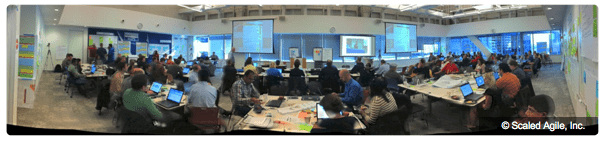
PI Planning has a standard calendar that includes a presentation of business context and vision, followed by team planning breakouts—where the teams create their Iteration plans and objectives for the upcoming Program Increment (PI). Facilitated by the Release Train Engineer (RTE), this outcome includes all members of the ART and occurs within the Innovation and Planning (IP) Iteration. Holding the outcome during the IP iteration avoids affecting the scheduling, or capacity of other iterations in the PI. PI Planning takes identify over two days, although this is ofttimes extended to conform planning beyond multiple time zones.
Business Benefits of PI Planning
PI planning delivers many business benefits, including:
- Establishing face-to-face communication across all team members and stakeholders
- Building the social network the ART depends upon
- Aligning development to business goals with the business context, vision, and Team and Program PI objectives
- Identifying dependencies and fostering cross-squad and cantankerous-Fine art collaboration
- Providing the opportunity for 'simply the right corporeality' of architecture and Lean User Feel (UX) guidance
- Matching demand to capacity and eliminating excess Work in Process (WIP)
- Fast controlling
Inputs and Outputs of PI Planning
Inputs to PI planning include:
- Concern context (meet 'content readiness' below)
- Roadmap and vision
- Acme x Features of the Program Backlog
A successful PI planning event delivers two primary outputs:
- Committed PI objectives – A prepare of SMART objectives that are created by each team with the business value assigned by the Business concern Owners.
- Program board – Highlighting the new characteristic delivery dates, feature dependencies among teams and relevant Milestones.
Preparation
PI planning is a significant result that requires preparation, coordination, and communication. It is facilitated by the RTE and result attendees include Business Owners, Product Management, Active Teams, Organisation and Solution Architects/Engineering, the Organisation Team, and other stakeholders, all of whom must exist notified in advance to be well prepared. The active participation of Business Owners in this result provides an important Guardrail on monetary spend.
For the result to be successful, training is required in three major areas:
- Organizational readiness – Strategic alignment and teams and trains setup
- Content readiness – Direction and development preparedness
- Logistics readiness – Considerations for running a successful event
Below are highlights of the ART Readiness Checklist. (The full checklist is provided in the Condom PI Planning Toolkit, available to SPCs).
Organizational Readiness
Before PI planning, there must be strategy alignment among participants, stakeholders, and Business Owners. Disquisitional roles are assigned. To address this in accelerate, however, event organizers must consider the following:
- Planning scope and context – Is the scope (production, organisation, applied science domain) of the planning process understood? Do nosotros know which teams need to program together?
- Business alignment – Is there reasonable understanding on priorities among the Business Owners?
- Agile teams – Do we have Agile teams? Are there defended team members and an identified Scrum Master and Production Owner for each team?
Content Readiness
Information technology'southward equally important to ensure that in that location is a articulate vision and context and that the right stakeholders can participate. Therefore, the PI planning must include:
- Executive briefing – A briefing that defines the current concern context
- Product vision briefing(southward) – Briefings prepared past Product Management, including the top x features in the Program Excess
- Compages vision briefing – A presentation made by the CTO, Enterprise Architect, or Organisation Builder to communicate new Enablers, features, and Nonfunctional Requirements (NFRs)
Logistics Readiness
Preparing an result to back up a large number of attendees isn't trivial. For physically collocated planning this tin can include securing and preparing the physical space. For remote attendees, or for a fully distributed PI Planning, this too includes investment in the necessary technical infrastructure. Considerations include:
- Locations – Each planning location must be prepared in advance
- Engineering science and tooling – Existent-time admission to information and tooling to support distributed planning or remote attendees
- Advice channels – Primary and secondary audio, video, and presentation channels must be available
Standard Agenda
The event follows an agenda similar to Figure 2. Descriptions of each item follow. For guidance on adapting this agenda to support planning across multiple time zones, refer to the advanced topic commodity, Distributed PI Planning with Condom.

Day i Calendar
- Business context – A Business Owner or senior executive describes the current land of the business, shares the Portfolio Vision, and presents a perspective on how finer existing solutions are addressing current customer needs.
- Product/solution vision – Production Direction presents the current vision (typically represented past the next top x upcoming features) and highlights any changes from the previous PI planning event, as well as whatsoever forthcoming Milestones.
- Architecture vision and development practices – System Builder/Engineering science presents the compages vision. Also, a senior development manager may introduce Active-supportive changes to development practices, such as test automation, DevOps, Continuous Integration, and Continuous Deployment, which are being advanced in the upcoming PI.
- Planning context and tiffin – The RTE presents the planning process and expected outcomes.
- Team breakouts #1 – In the breakout, teams estimate their chapters for each Iteration and identify the backlog items they will likely need to realize the features. Each squad creates their typhoon plans, visible to all, iteration by iteration.
During this process, teams place risks and dependencies and draft their initial squad PI objectives. The PI objectives typically include 'uncommitted objectives,' which are goals built into the program (due east.g., stories that have been divers and included for these objectives), but are non committed to by the squad because of besides many unknowns or risks. Uncommitted objectives are not extra things to do in example there is time. Instead, they increment the reliability of the plan and give management an early warning of goals that the ART may not be able to deliver. The teams also add the features and associated dependencies to the program board, as shown in Figure 3.

- Draft plan review – During the tightly timeboxed draft plan review, teams present cardinal planning outputs, which include capacity and load, draft PI objectives, potential risks, and dependencies. Business Owners, Product Management, and other teams and stakeholders review and provide input.
- Management review and problem-solving – It's likely that the draft plans present challenges such as scope, people and resource constraints, and dependencies. During the trouble-solving meeting, management may negotiate scope changes and resolve other problems by agreeing to various planning adjustments. The RTE facilitates and keeps the primary stakeholders together for as long as necessary to brand the decisions needed to reach achievable objectives.
In multi-ART Solution Trains, a similar result may exist held afterward the first solar day of planning to resolve cantankerous-Art issues that accept come up up. Alternatively, the RTEs of the involved trains may talk with each other to raise problems that are and then resolved in each ART's specific management review and problem-solving meeting. The Solution Train Engineer (STE) helps facilitate and resolve issues across the ARTs.
Day 2 Agenda
- Planning adjustments – The side by side twenty-four hour period, the event begins with management presenting whatsoever changes to planning scope, people, and resource.
- Team breakouts #two – Teams continue planning based on their agenda from the previous day, making the appropriate adjustments. They finalize their objectives for the PI, to which the Business Owners assign business value, as shown in Effigy 4.

Effigy 4. A team's PI objectives sheet with assigned business value - Final programme review and lunch – During this session, all teams present their plans to the group. At the end of each team'due south time slot, the team states their risks and impediments and provides the risks to the RTE for utilize later in the ROAMing exercise. The team then asks the Business Owners if the plan is adequate. If the plan is accepted the squad brings their squad PI objective sheet to the forepart of the room so anybody can see the aggregate objectives unfold in real-time. If the Business Owners take concerns, teams are given the opportunity to adjust the programme as needed to address the problems identified. The team so presents their revised plan.
- Program risks – During planning, teams have identified program risks and impediments that could touch on their ability to meet their objectives. These are resolved in a broader management context in front of the whole train. One by ane, the risks are discussed and addressed with honesty and transparency, and then categorized into one of the post-obit categories:
- Resolved – The teams agree that the take a chance is no longer a concern.
- Owned – Someone on the train takes ownership of the gamble since it cannot exist resolved during PI planning.
- Accepted – Some risks are merely facts or potential problems that must be understood and accepted.
- Mitigated – Teams identify a programme to reduce the affect of the run a risk.
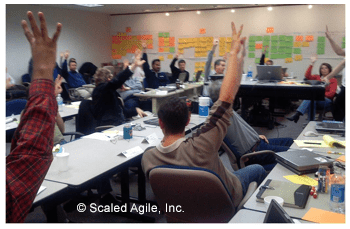
- Confidence vote – Once programme risks have been addressed, teams vote on their confidence in coming together their squad PI objectives.
Each squad conducts a 'fist of five' vote. If the average is iii fingers or above, so direction should accept the commitment. If it's less than three, the team reworks the plan. Any person voting two fingers or fewer should be given an opportunity to vocalization their concerns. This might add to the listing of risks, require some re-planning, or simply be informative. One time each team has voted the process is repeated for the entire Art with anybody expressing their conviction in the commonage plan, as illustrated in Effigy five.
- Program rework – If necessary, teams rework their plans until a high confidence level tin be reached. This is ane occasion where alignment and commitment are valued more highly than adhering to a timebox.
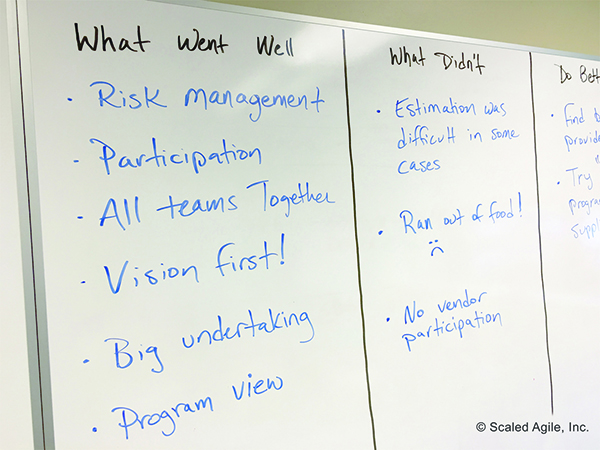
- Planning retrospective and moving forward – Finally, the RTE leads a brief retrospective for the PI planning event to capture what went well, what didn't, and what can exist done better next time, as shown in Figure vi.
- Typically a give-and-take about the next steps, forth with final instructions to the teams, follows. This might include:
- Cleaning upwardly the rooms used for planning.
- Capturing the team PI objectives and stories in an Agile project management tool.
- Reviewing team and Art events calendars.
- Determining Iteration Planning and daily stand-upwardly (DSU) locations and timings.
After the planning event is done, the RTE and other ART stakeholders summarize the individual squad PI objectives into a set of program PI objectives (Figure seven) and use this to communicate externally and to runway progress toward the goals.
Production Direction uses the plan PI objectives to update the roadmap and volition better the forecast for the adjacent ii PIs, based on what was just learned.
The program board is often used during the Scrum of Scrums to rails dependencies. It may, or may not, be maintained (manually) afterward planning is complete. This depends upon the Agile project direction tooling in place and the needs of the ART.
Teams leave the PI planning event with a prepopulated iteration backlog for the upcoming PI. They have their squad'south PI objectives, iteration plans, and risks back to their regular work surface area. Plan risks remain with the RTE, who ensures that the people responsible for owning or mitigating a risk have captured the information and are actively managing the risk.
Well-nigh of import, the Fine art proceeds to execute the PI, tracking progress and adjusting as necessary to the changes that occur equally new knowledge emerges. Execution of the PI begins with all the teams conducting planning for the start iteration, using their PI plans equally a starting point. This is fresh input for the iteration planning processes that follow. Since the iteration plans created during PI Planning did not take into account detailed story level credence criteria, it'due south likely that adjustments will need to be made to the first and subsequent iteration plans.

Solution Train PI Planning
This commodity focuses on the planning activities of a unmarried ART. Yet, big Value Streams may contain multiple ARTs and suppliers. In this case, the Solution Railroad train provides coordination using a Pre-PI Planning event, which sets the context and provides the inputs for the individual ART PI planning events. A Post-PI Planning event follows Fine art PI planning and is used to integrate the planning results of the ARTs that contribute to the solution.

The Innovation and Planning Iteration article provides an instance calendar for accommodating Pre- and Post-PI planning events.
Learn More than
[one] Leffingwell, Dean. Agile Software Requirements: Lean Requirements Practices for Teams, Programs, and the Enterprise. Addison-Wesley, 2022.
[2] Kennedy, Michael. Product Development for the Lean Enterprise.Oaklea Press, 2003.
Final update: ten Feb 2022
The information on this page is © 2022-2022 Scaled Active, Inc. and is protected by US and International copyright laws. Neither images nor text tin exist copied from this site without the express written permission of the copyright holder. Scaled Agile Framework and Safe are registered trademarks of Scaled Active, Inc. Please visit Permissions FAQs and contact u.s.a. for permissions.
© 2022 Scaled Active, Inc. All rights reserved.

Source: https://www.scaledagileframework.com/pi-planning/
Posted by: santiagowareatur.blogspot.com
0 Response to "How To Draw Pi Bonding Framework"
Post a Comment