

How To Draw Characteristic Curves Pde
In mathematics, the method of characteristics is a technique for solving fractional differential equations. Typically, it applies to beginning-order equations, although more generally the method of characteristics is valid for any hyperbolic partial differential equation. The method is to reduce a partial differential equation to a family of ordinary differential equations forth which the solution can be integrated from some initial information given on a suitable hypersurface.
Characteristics of beginning-club fractional differential equation [edit]
For a first-order PDE (partial differential equation), the method of characteristics discovers curves (called characteristic curves or just characteristics) along which the PDE becomes an ordinary differential equation (ODE).[1] One time the ODE is found, it can be solved along the characteristic curves and transformed into a solution for the original PDE.
For the sake of simplicity, we confine our attention to the instance of a function of 2 contained variables x and y for the moment. Consider a quasilinear PDE of the grade
-
(1)

Suppose that a solution z is known, and consider the surface graph z =z(10,y) in R three. A normal vector to this surface is given by
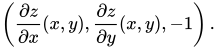
Every bit a result,[2] equation (1) is equivalent to the geometrical statement that the vector field

is tangent to the surface z =z(x,y) at every point, for the dot product of this vector field with the above normal vector is zero. In other words, the graph of the solution must be a union of integral curves of this vector field. These integral curves are called the characteristic curves of the original partial differential equation and are given by the Lagrange–Charpit equations [3]
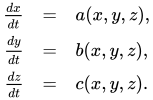
A parametrization invariant form of the Lagrange–Charpit equations [3] is:

Linear and quasilinear cases [edit]
Consider now a PDE of the form

For this PDE to exist linear, the coefficients a i may exist functions of the spatial variables simply, and independent of u. For it to exist quasilinear,[4] a i may also depend on the value of the office, but not on any derivatives. The distinction between these 2 cases is inessential for the give-and-take here.
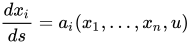
For a linear or quasilinear PDE, the feature curves are given parametrically by


such that the following system of ODEs is satisfied
-
(2)
-
(3)
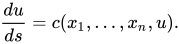
Equations (2) and (3) give the characteristics of the PDE.
Proof for quasilinear Case [edit]
In the quasilinear case, the employ of the method of characteristics is justified by Grönwall'southward inequality. The above equation may be written as

Nosotros must distinguish betwixt the solutions to the ODE and the solutions to the PDE, which we exercise non know are equal a priori. Letting capital letters be the solutions to the ODE we find


Examining , we discover, upon differentiating that


which is the same as

We cannot conclude the in a higher place is 0 as nosotros would similar, since the PDE just guarantees us that this relationship is satisfied for , , and we practise not nevertheless know that .


All the same, we can encounter that

since by the PDE, the last term is 0. This equals

By the triangle inequality, we have

Assuming are at least , we tin can leap this for minor times. Choose a neighborhood effectually small enough such that are locally Lipschitz. By continuity, will remain in for small enough . Since , we also have that will exist in for modest enough by continuity. So, and for . Additionally, for some for by compactness. From this, we find the above is bounded equally


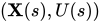





![{\displaystyle s\in [0,s_{0}]}](https://wikimedia.org/api/rest_v1/media/math/render/svg/9f9a6a127fd26012509e1aae53fb876d158bdf0b)



for some . Information technology is a straightforward awarding of Grönwall's Inequality to prove that since we take for equally long every bit this inequality holds. We have some interval such that in this interval. Choose the largest such that this is true. And then, by continuity, . Provided the ODE notwithstanding has a solution in some interval after , nosotros can repeat the statement above to find that in a larger interval. Thus, so long as the ODE has a solution, we take .





Fully nonlinear example [edit]
Consider the partial differential equation
-
(four)

where the variables p i are shorthand for the partial derivatives

Allow (10 i(s),u(s),p i(due south)) be a curve in R 2n+one. Suppose that u is any solution, and that

Forth a solution, differentiating (4) with respect to s gives

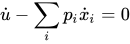
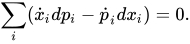
The second equation follows from applying the chain rule to a solution u, and the tertiary follows by taking an exterior derivative of the relation . Manipulating these equations gives
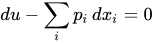

where λ is a constant. Writing these equations more symmetrically, one obtains the Lagrange–Charpit equations for the characteristic

Geometrically, the method of characteristics in the fully nonlinear example tin can be interpreted every bit requiring that the Monge cone of the differential equation should everywhere exist tangent to the graph of the solution.
Case [edit]
Every bit an example, consider the advection equation (this example assumes familiarity with PDE annotation, and solutions to basic ODEs).
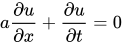
where is constant and is a function of and . We desire to transform this linear first-order PDE into an ODE along the appropriate curve; i.e. something of the form



where is a characteristic line. First, we discover


by the concatenation dominion. Now, if nosotros set and nosotros get


which is the left hand side of the PDE we started with. Thus
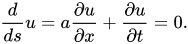
Then, forth the characteristic line , the original PDE becomes the ODE . That is to say that along the characteristics, the solution is abiding. Thus, where and lie on the same characteristic. Therefore, to determine the general solution, it is enough to notice the characteristics by solving the characteristic system of ODEs:




In this example, the characteristic lines are directly lines with slope , and the value of remains abiding along any feature line.
Characteristics of linear differential operators [edit]
Let Ten be a differentiable manifold and P a linear differential operator

of order k. In a local coordinate arrangement 10 i ,
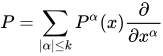
in which α denotes a multi-index. The principal symbol of P, denoted σ P , is the role on the cotangent package T∗ X defined in these local coordinates by
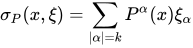
where the ξ i are the cobweb coordinates on the cotangent bundle induced by the coordinate differentials dx i . Although this is defined using a particular coordinate system, the transformation constabulary relating the ξ i and the x i ensures that σ P is a well-defined function on the cotangent bundle.
The function σ P is homogeneous of degree k in the ξ variable. The zeros of σ P , abroad from the zero department of T∗ X, are the characteristics of P. A hypersurface of X defined by the equation F(x) =c is chosen a characteristic hypersurface at x if

Invariantly, a characteristic hypersurface is a hypersurface whose conormal package is in the characteristic set of P.
Qualitative analysis of characteristics [edit]
Characteristics are besides a powerful tool for gaining qualitative insight into a PDE.
One can utilise the crossings of the characteristics to find shock waves for potential period in a compressible fluid. Intuitively, we can think of each characteristic line implying a solution to along itself. Thus, when two characteristics cross, the function becomes multi-valued resulting in a non-concrete solution. Physically, this contradiction is removed by the formation of a shock moving ridge, a tangential discontinuity or a weak aperture and tin can result in not-potential flow, violating the initial assumptions.[5]
Characteristics may neglect to cover part of the domain of the PDE. This is called a rarefaction, and indicates the solution typically exists merely in a weak, i.eastward. integral equation, sense.
The direction of the feature lines indicate the flow of values through the solution, as the example to a higher place demonstrates. This kind of noesis is useful when solving PDEs numerically as it can indicate which finite difference scheme is all-time for the problem.
See likewise [edit]
- Method of quantum characteristics
Notes [edit]
- ^ Zachmanoglou, East. C.; Thoe, Dale West. (1976), "Linear Partial Differential Equations : Characteristics, Classification, and Canonical Forms", Introduction to Fractional Differential Equations with Applications, Baltimore: Williams & Wilkins, pp. 112–152, ISBN0-486-65251-3
- ^ John, Fritz (1991), Partial differential equations (fourth ed.), Springer, ISBN978-0-387-90609-6
- ^ a b Delgado, Manuel (1997), "The Lagrange-Charpit Method", SIAM Review, 39 (2): 298–304, Bibcode:1997SIAMR..39..298D, doi:10.1137/S0036144595293534, JSTOR 2133111
- ^ "Fractional Differential Equations (PDEs)—Wolfram Language Documentation".
- ^ Debnath, Lokenath (2005), "Conservation Laws and Shock Waves", Nonlinear Fractional Differential Equations for Scientists and Engineers (2nd ed.), Boston: Birkhäuser, pp. 251–276, ISBN0-8176-4323-0
References [edit]
- Courant, Richard; Hilbert, David (1962), Methods of Mathematical Physics, Volume II, Wiley-Interscience
- Evans, Lawrence C. (1998), Partial Differential Equations, Providence: American Mathematical Society, ISBN0-8218-0772-2
- Polyanin, A. D.; Zaitsev, V. F.; Moussiaux, A. (2002), Handbook of First Order Partial Differential Equations, London: Taylor & Francis, ISBN0-415-27267-X
- Polyanin, A. D. (2002), Handbook of Linear Fractional Differential Equations for Engineers and Scientists, Boca Raton: Chapman & Hall/CRC Press, ISBNone-58488-299-nine
- Sarra, Scott (2003), "The Method of Characteristics with applications to Conservation Laws", Journal of Online Mathematics and Its Applications .
- Streeter, VL; Wylie, EB (1998), Fluid mechanics (International 9th Revised ed.), McGraw-Hill College Instruction
External links [edit]
- Prof. Scott Sarra tutorial on Method of Characteristics
- Prof. Alan Hood tutorial on Method of Characteristics

Source: https://en.wikipedia.org/wiki/Method_of_characteristics
Posted by: santiagowareatur.blogspot.com
0 Response to "How To Draw Characteristic Curves Pde"
Post a Comment